Nerdle vs Mathler: What's the Difference (and Which Should You Play in 2026)?
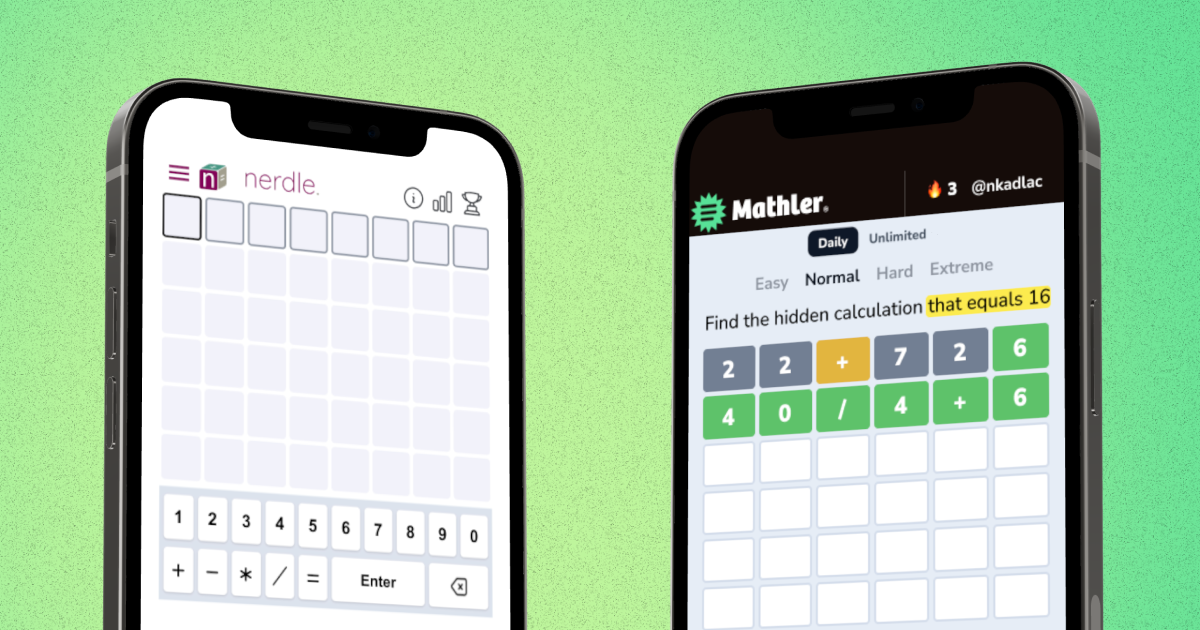
We get this question a lot. Is Mathler basically Nerdle? Or Nerdle basically Mathler?
Short answer: no. They look similar — same six tries, same color-feedback system pinched from Wordle — but the underlying game is different in a way that changes how you actually play. If Wordle kicked off the daily games era in 2022, Nerdle and Mathler are the numerical spinoffs that took the format somewhere else entirely.
What is Nerdle?
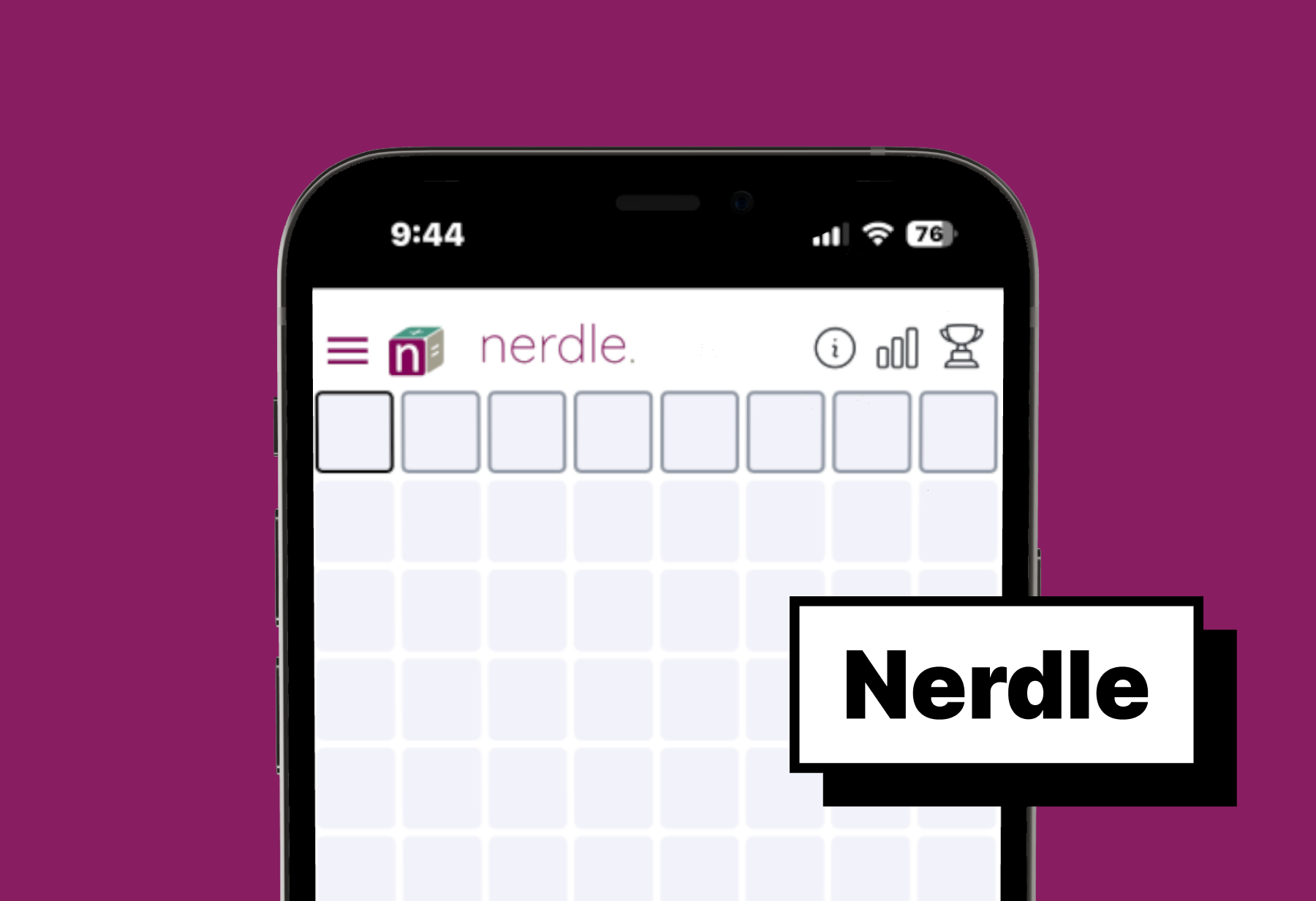
Nerdle is a free daily math puzzle game. You're hunting for a hidden calculation. Six tries, eight slots per guess, and every guess has to be a valid equation — numbers, operators (+, -, ×, ÷), and an = sign somewhere in there. Drop in a guess and the tiles turn green for characters in the correct position, yellow for characters in the wrong spot, and gray for anything that isn't in the answer at all.
Nerdle has since grown into the "Nerdleverse" — a family of variants that includes Mini Nerdle (smaller grid, gentler on beginners), Speed Nerdle, Instant Nerdle, Crossnumber, and a custom puzzle maker.
What is Mathler?
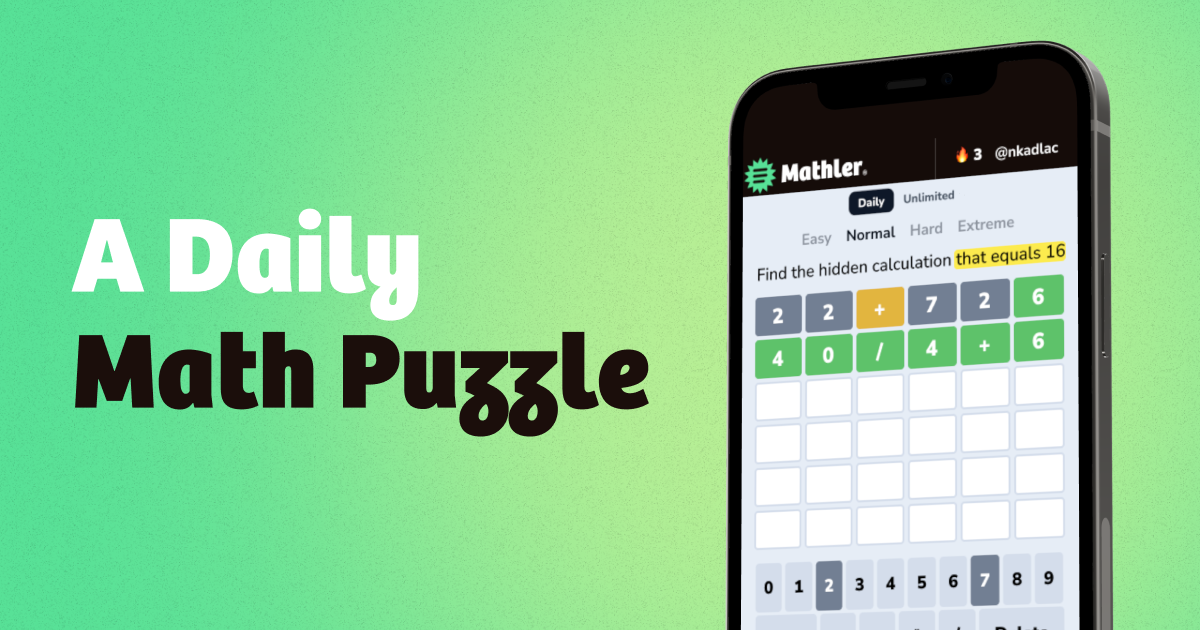
Mathler is a free daily math puzzle that flips Nerdle's premise. Instead of guessing a blind equation, you see a target number at the top of the board, and your job is to build an expression that equals it. Same six tries. Same color feedback: green for a character in the correct spot, yellow for one that's close but misplaced, gray for characters that aren't in the answer. Mathler also accepts commutative answers — if the solution is 5+3+2, then 3+5+2 or 2+5+3 all count. Order doesn't matter, only the math does.
Four difficulty levels: Easy, Normal, Hard, Extreme. Extreme earns the name. There's also a Practice Mode for unlimited play that doesn't touch your streak.
Nerdle vs Mathler at a glance
Side-by-side comparison:
Feature | Nerdle | Mathler |
|---|---|---|
Core mechanic | Equation-centric | Expression-centric |
Target number shown? | No — guess blind | Yes — target visible from guess one |
Tries per puzzle | 6 | 6 |
Input slots | 8 (fixed) | 5, 6, or 8 (depends on difficulty) |
Characters used |
|
|
Difficulty levels | One core mode + variants | Easy / Normal / Hard / Extreme |
Practice mode | Archive only | Dedicated Practice Mode |
Typical solve time | 6–10 minutes | 3–6 minutes (Normal) |
Custom puzzle maker | Yes | No |
Classroom printables | Paid puzzle book | Free downloadable e-book |
Color feedback | Green / yellow / gray | Green / yellow / gray |
PEMDAS required | Yes | Yes |
Free to play | Yes | Yes |
Signup required | No | No |
Best for | Equation-building, variant hunters | Mental math, classrooms, short sessions |
What Nerdle and Mathler have in common
Plenty:
- Both are daily math puzzles with a fresh puzzle every 24 hours
- Both give you six tries
- Both use a Wordle-inspired color system — green for correct spot, yellow for wrong spot, gray for not in the solution
- Both use the same four operators (
+,-,×,÷) - Both reward mental math, logical deduction, and a working grip on PEMDAS
- Both are free, browser-based, and signup-free
- Both work well in classrooms, and both ship with printables teachers actually use
If you like one, you'll probably like the other. Same small daily pleasure Wordle and the rest of the daily word games kicked off — just with digits instead of letters.
What's actually different
The table shows you the specs. Here's what those specs feel like once you're playing.
Equation vs. expression
This is the whole ballgame.
Nerdle is an equation game. You're trying to uncover a hidden calculation — every guess is a complete equation with an = sign living somewhere in the eight slots, and your opening guess is effectively a dart throw. You're lobbing in something reasonable and reading the colors.
Mathler is an expression game. The target number is sitting right there from the start, so every guess has a direction. You're writing the left side of an equation whose right side has already been handed to you. That one shift is what changes everything downstream. Mathler plays faster, it's friendlier for beginners, and it's a sharper PEMDAS workout — because you have to reason about order of operations on every guess to make the expression hit the target. And because Mathler accepts commutative answers, you don't have to guess the exact arrangement the solver had in mind; any valid rearrangement that hits the target counts.
Input slots
Nerdle's eight slots never change. Mathler scales with difficulty: 5 slots on Easy, 6 on Normal, 8 on Hard and Extreme (with nastier target numbers to match).
Playtime
Mathler is the quicker game. The target number anchors you from the jump; Nerdle's blind-opener phase adds minutes. Mathler is the espresso shot. Nerdle is the pour-over.
Variants
Nerdle has more. The Nerdleverse includes Speed Nerdle, Instant Nerdle, Crossnumber, a smaller beginner-friendly grid, and a custom puzzle maker. Mathler keeps things tight — one clean game, four difficulty tiers that meaningfully escalate, plus Practice Mode for unlimited reps.
Which one should you play?
Comes down to what you want.
Play Nerdle if you want:
- To build full equations from scratch
- A bigger catalog of variants and spinoffs
- To make your own math puzzles for friends, students, or family
- A stricter, blind-guess format that leans harder into challenge
Play Mathler if you want:
- A faster puzzle you can finish on a coffee break (3–6 minutes)
- Four tunable difficulty levels from Easy to Extreme
- A dedicated Practice Mode that doesn't touch your streak
- A stronger order of operations workout
- Free, classroom-ready printables — grab the free e-book
- A game that's actually solvable on the first guess on Easy (happens more than you'd think)
Play both if you want to turn your morning coffee into a daily math puzzle routine. Honestly? That's what most Mathler regulars do — they're alternating between Nerdle, Mathler, Sumplete, a Sudoku, and whatever other games have earned a slot in their daily rotation. Stacking daily games sharpens different mental muscles at once.
Strategies that work for both puzzle games
Get better at one, you get better at the other. The moves that transfer:
High-information openers. Cram as many different digits and at least two different operators into your first guess. The more unique characters you expose, the more the color system has to tell you.
Read the colors seriously. Green characters are in the correct position — lock them down and build around them. Yellow means right character, wrong place — move it somewhere else. Gray kills a character; don't bring it back. This sounds obvious and is the single most common mistake.
PEMDAS before anything else. The order of operations is what makes these puzzles tick. Multiplication and division before addition and subtraction. If you're rusty, our order of operations game is a short, painless warmup.
Think in factors. If the target is 72, your brain should be firing 8×9, 12×6, 24×3 — not just addition pairs. Factoring the target fast is half the battle, especially on Mathler Hard and Extreme.
Keep a scratch pad. Especially on the tougher difficulties. Jotting candidate expressions alongside the color state saves guesses you'd otherwise waste.
FAQ
Is Mathler or Nerdle harder?
Both get tough at the higher difficulties. At baseline — Nerdle Classic vs Mathler Normal — Nerdle edges it, because you're building the equation blind. Mathler's target number gives you a running start.
Are Nerdle and Mathler both "math Wordles"?
Yes. Both are inspired by Wordle and run the same color-feedback mechanic you see in daily word games, except on numbers. They're the two most recognizable math Wordles, but there are others — Numberle, Summle, and a long tail of smaller ones.
Do digits or operators repeat in the answers?
Sometimes. Both games occasionally land on things like 5+5+5 or 2×2×2, but repeats are the exception.
Does PEMDAS matter in both?
Yes — it's load-bearing. Both games enforce the order of operations. Solve left-to-right instead of by PEMDAS and you'll burn guesses on answers that don't evaluate the way you think they do.
Can I practice without risking my streak?
Mathler has a dedicated Practice Mode for exactly that — unlimited puzzles, streak untouched. Nerdle handles streaks differently and doesn't have a built-in risk-free practice environment.
How long does each math puzzle take?
Nerdle: around 6–10 minutes. Mathler: 3–6 minutes on Normal, sometimes 10+ on Extreme if the target number is in a bad mood.
Does Mathler accept commutative answers?
Yes — this is one of the more generous things about Mathler. If the target is 10 and the solver had 5+3+2 in mind, then 3+5+2, 2+3+5, and any other valid rearrangement also count. Commutative answers get credit because the math is what matters, not the specific arrangement. Nerdle doesn't work this way — Nerdle is guessing a specific hidden calculation, so you have to match the exact order. Mathler's commutative answers policy is one reason the game runs faster and feels less punishing on near-misses.
What's Mini Nerdle?
Mini Nerdle is a smaller Nerdle variant with fewer input slots — a lower-commitment version that's popular with kids and beginners. Mathler's closest equivalent is Easy mode (5 slots, friendlier target numbers).
Can I embed these games?
Mathler, yes — teachers put us on class pages all the time, and we love being embedded. Nerdle doesn't publicly offer an embed.
Which is better for classroom use?
Both are solid. Mathler tends to fit classrooms better because of the shorter playtime, the four difficulty levels (one teacher can serve multiple grade levels at once), and the free printable e-book. Our best daily math puzzles roundup has more classroom-friendly options if you want to stock up.
Are Nerdle and Mathler free?
Yes. Both play free in the browser, no account required.
How do Nerdle and Mathler fit into a daily puzzle routine?
Both are short enough to work as part of a larger daily math puzzle habit. A lot of players we hear from run Mathler and Nerdle back-to-back — Mathler first, because the target number gives you a mental warmup, then Nerdle's tougher blind-guess phase. Tack a Sudoku or Sumplete onto the end and you've got a complete brain breakfast. The daily games scene rewards variety more than depth in any single title, so rotating across a few titles keeps the habit alive longer than marathoning one.
The verdict: Nerdle vs Mathler
Nerdle and Mathler aren't rivals. They're two different ways to spend the same six tries. Nerdle wants you to build the sentence. Mathler hands you the answer and asks you to show your work. Neither is better — they pull on slightly different mental muscles.
If you're making us pick one, well — we run Mathler, so guess which way we lean. But the real answer is alternate. Nerdle on odd days, Mathler on even. Your PEMDAS gets sharper and you don't have to choose.
Play today's Mathler if you're in. Free, four difficulty levels, no signup.
 Mini Crossword
 Midi Crossword
 Diffle
 Killer Sudoku
 Numberle